So, hey guys, Alex here and in today's video I have a topic for you and I've covered this to some extent in other videos, but I think that this hasn't exactly been totally covered by myself.
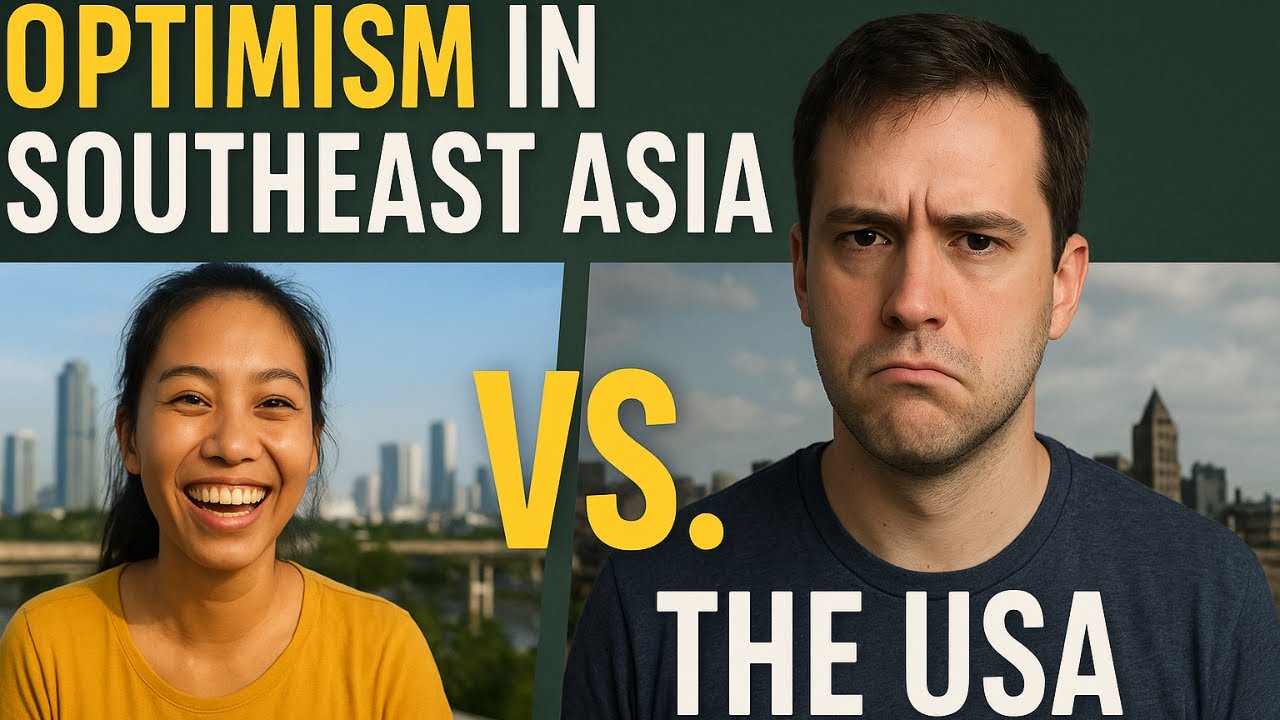
This topic for today is why does life in Southeast Asia seem more optimistic than life in the United States?
And this is just something I noticed.
I was reflecting on a conversation I had with a buddy of mine who's a subscriber to this channel and we were talking about life in the Philippines versus life in the United States.
we both spent a lot of time in the Philippines and we're both from the United States.
And he said, I think they just don't have the same cynicism that we have uh in the United States.
And I thought I'd get into that and talk about why I think that is.
And um so I made a brief outline to discuss this.
And feel free if you don't agree with any of my points or you'd add any points to comment down below.
Uh but let's go ahead and get into it.
So the first point here is the economy.
A lot of economies in Southeast Asia are rapidly growing.
Where I spent u much of 202 uh well a good chunk of 2024 and 2025.
The Philippines uh the economy I think grew like 6% last year.
So it's growing really really fast and there's a sense of optimism in the air that things are getting better.
I know Vietnam is also growing really fast.
Cambodia, uh, Indonesia, and there's this sense in the air that like things are just going to continue to improve and, uh, people are getting wealthier and development is happening.
Meanwhile, in the United States, like just my experience, I just drove across the United States last week and I drove almost from coast to coast and I noticed that especially like in the rural areas, the in between places, things seem to be kind of declining, you see a lot of rundown buildings, you see a fair amount of abandoned buildings.
It's not like that.
If you're in like a hot city like in Austin or uh Nashville or you're in Los Angeles, it probably doesn't feel that way.
But like there's a lot of what seem to be forgotten places across the country.
And it seems like in a number of these places, their best days are behind them.
When I go to Southeast Asia, I'm usually seeing new buildings.
I'm seeing new restaurants.
I'm seeing new hotels.
I'm seeing improvements in infrastructure like they're expanding public transportation systems.
I saw this a lot in Bangkok, Thailand where over the course of my year there, they would be opening new transit stations like every other month it seemed like there was a new one open and you just don't see that as much.
Like think about San Francisco uh where I I lived near there for several years.
In the time that I lived there, I think they opened one public transit stop over the course of off and on for like five or six years.
So you just compare that kind of growth.
Like the economy seems to be growing well not just seems to be is visually growing a lot faster throughout Southeast Asia.
And it doesn't mean the US economy isn't growing at all, but the growth seems to be one slower, but also two concentrated to a couple of industries or a couple of big cities and doesn't seem to be uh quite as across the board, if that makes any sense.
So that's reason number one.
I think reason number two would be collectivism and it's tied in with reason number one where it seems like in Southeast Asia right now.
I get this feeling it's like we're all winning together.
We're all succeeding together where in the US for those who have not benefited from some of the recent economic booms.
It's almost like you feel like I'm failing alone.
Uh or if I'm succeeding I'm succeeding but I don't have anyone to share it with.
And I've had a number of friends that are high earners and there's still this sort of sense of loneliness like yeah I'm got the material wealth but I'm far away from my family.
I've had to move to a big city uh or a small town or wherever.
I had to move to a specific place to take part in this economic growth where I'm far away from my loved ones and I'm you know my bank account's doing well but as far as my interpersonal life I've had to sacrifice a lot of time uh to succeed where my experience in Southeast Asia like a number of my friends have been doing well economically they also happen to live in cool cities where uh they what's the word they have like vibrant socialized outside of work.
Like they work really hard, they work a lot of hours, but then after work they're getting together with friends and uh you know, people they want to spend time around.
And it I don't know.
I just feel like it's uh it's just it's something I noticed um a lot of them too.
Like a lot of my I think the one of the big differences is a lot of my friends in big Southeast Asian cities have moved there with their families or their they grew up there with their families where here in the US maybe it's cuz I didn't grow up in a big city but a lot of my friends in big cities here in the US they had to move there.
They've actually had to move there from somewhere else.
Uh so they're not down the street from like extended family.
Uh families are also smaller.
So, uh, that's just something else I noticed this collectivism where it's not just that people are succeeding, but they're also succeeding with, uh, people they care about.
And people they care about are like, "Oh, I remember when you got your first entry-level job and now you're a mid-level manager." Uh, or, you know, if you if they they're struggling at work, they come home, they have people to talk about it.
Uh I've definitely had experiences being like having troubles at work and I don't have anybody to talk about it really with really.
So, uh, that's a big difference, too.
This individualism factor in the US where I think a lot of the people that I can think of that I grew up around, they definitely struggle with loneliness, with isolation.
Uh, not just one type of person.
It's not just a, oh, there it's personal responsibility.
I think it is a cultural thing where people feel more isolated.
They they feel like they don't have people to talk to as much.
um they they I don't know if it's they want connection, can't get it for whatever reason, but that's a big difference I noticed between my time in Southeast Asia verse being back in the US.
Uh number three, I talked a bit about this in point number one, so I might skip to um point number four, or I could just roll them together, but point number three, we'll move on to aging.
So one of the things you notice in Southeast Asia and this is more pronounced in Indonesia, Philippines and Cambodia, but to some extent Vietnam.
I think a little less so in Thailand.
Uh I think Thailand is an aging society, but you see like a lot of young people out and about and that's one of the first things you notice when you get back to the States from a trip to Asia is the average person seems older.
I'm I'm not a spring chicken myself.
Uh but I'm actually younger than the median American.
So I'm in my early to mid30s and I think the median American is like late 30s.
So uh when when you have a younger population, there's just a greater in my opinion a greater sense of optimism like hey my life is going to keep getting better.
Uh the economy is growing really fast.
I'm going to move up at work.
I'm going to be able to purchase my first home.
I I'm going to hit all these I have all these milestones ahead of me, right?
Where uh here in the US when you have an older population, people I've my experience people are more like uh I'm I don't I I've heard this from a lot of of older uh people.
It's not to to put them down or or meant to be agist, but it's like I have my best days behind me.
I'm in the last innings.
Um I I'm not going to fall in love for the first time.
I'm not going to start a new family.
Like I just uh you know I may be in physical pain.
I may have health issues.
I may be taking medication.
I don't have the same capacity to be optimistic and and have something to look forward to like uh you would if you were in a you know that kind of you have you didn't have that this common theme that seems to be going on these demographic uh concerns where like who's going to pay into the public systems for us where that's not really a concern as much in like a Philippines where most most I think average Filipino is like 27 uh So you don't have this uh this issue that you have in the western democracies.
I think this applies to the UK, Australia, uh Canada as well.
Um and I'm not going to get into the political consequences of this, but it's just worth pointing out that uh also I think young people contribute to innovation.
Like a lot of the tech companies you could probably think of were often founded by fairly young people.
And uh so I you know one of the things like I follow this guy Naval online he's talked about you need young people to innovate to create new things and I his concern about the demographic issues in the west are that they could lead to less innovation uh compared to the past.
So that's something to consider.
Uh the fourth point I would point out and you could spot my my notes I took on my hand here is the media.
So I noticed like western media seems to be very overall cynical, negative, focused on crisis.
I have to hit block block constantly on uh my different platforms I use.
No, I don't want to hear about uh this bad thing, that bad thing.
Um these people are arguing or or getting into it again.
I don't I don't want to hear about all that.
I think it's just negative and it puts people in a sour mood.
uh where the media in Asia um I notice it's more optimistic like look we built this new thing or oh look this this new mall is opened or um oh we had this positive uh development we've just broken ground on a new airport um it just seems to be more optimistic and more uh encouraging kind of upbeat or excited attitude I don't know if that also ties into the economic growth but it's it's something I noticed like the media in Southeast Asia seems to just have a much more positive tone on average overall and it seems to be more uplifting.
Like I remember in Dumagedi they would always be excited to announce college graduations and and how big of a deal that was.
Look, we got a you see banners all over town which is uh really exciting.
Like look, we got a big new class of nursing students.
Oh, look at all these nursing graduates.
It's uh it's such an exciting thing to have these people succeed where I don't remember the last time I saw any kind of congratulations for new graduates.
Um here in the US it seems like graduations for college are fairly private events and I don't really see a lot of signage for that.
And um you know I maybe I'm just reading too much into things but I I found it so uplifting uh in Southeast Asia to just engage with the media and like oh look you know this new business just opened and they're going to have a grand opening and here it's like oh look there was this crime and there was that crime and this crime and that crime and I think a lot of people in the US they get like I can't speak for the other western countries but it's probably similar.
They get addicted to this like negative media and they get kind of hooked into it and they become like like hyper politicized where all they do like is watch political media or crime media and then they think that's the only two things that happens in the United States or political conflict or serious crimes.
And um I'm not going to discount the importance of those, but I don't think that that's like what people should spend all their time focusing on.
And uh that's something that I think contributes to Western cynicism is people think that crime is happening 24/7 everywhere.
Uh when it's more moderate than what it's made out to be.
And when people I think personally when people think that it's more dangerous than what it is, they don't go out as much.
They don't get as much fresh air.
Uh they're more distrusting of other people.
Um they're more suspicious.
They're more skeptical.
They um they may bring that negative energy.
Like if they're u addicted to political media, they may end relationships over it.
They may pick arguments or fights like it's um it seems like it used to not be that way but in recent years oh you you like Trump I don't want to be your friend anymore.
Oh you like Biden I don't want to be your friends friend anymore.
Even families I've heard actually have had deepseated familial problems uh as a consequence of this kind of like uh conflict and fr frustration.
And I think that leads people to be cynical too like oh I thought uh you know back in the day that family was was so important and now because we have a difference of opinion then we uh we can't get along and so it leads to isolation.
I think all these problems kind of feed into each other and it's uh it's really tragic.
Um the fifth and last the fifth and last reason that I would mention as far as uh why western people are more cynical.
That's tough because there's there's quite a few reasons I could mention here.
Um sorry about that guys.
just a a dog barking.
But um it's um you know I think some of it is tie I'll say the fifth point I'll tie back into the economy or economics and it seems like the golden era of the US economically is in the past like I've I've talked a bit about this in recent videos, but I watch Analyzing Finance with Nick.
Shout out to him.
He does a great channel, but he said he felt that the United States economy peaked in 2000.
And you get that sense like it's uh, you know, it's a lot of people point out the younger generations today are not going to live as well as the baby boomer generation.
and they're not going to have the same economic growth, the post-war boom.
And it I think it does lend itself to cynicism when people feel like the economy is getting worse and um buying a house is out of reach for a lot of the younger generations.
Uh it's, you know, people I think it does lend itself to people feeling hopeless like they're going to have a harder time uh attaining those milestones of previous generations.
And I think what makes it worse is in some at times they're held in contempt by some of the other generations like oh why aren't you growing up?
Why aren't you starting a family?
I myself have been asked that a number of times.
Why aren't you getting married?
Why aren't you starting a family?
Why aren't you having kids?
And you know if I point out I can't afford a like a single family home.
Uh, and by the time I will, it'll I'll probably be around 40 years old.
Maybe maybe not quite 40, but getting up there.
And it also may not be a priority for me.
I don't feel the same uh pressure to be try to live a traditional lifestyle.
Uh then there's a lot of frustration there I think too where it's like well you know some of uh some of those milestones that aren't getting reached like they're not indefinite like most people I think if they have a certain age at which like if I haven't had a kid at this point I'm not going to uh and there's biological limits there but also it's just like okay do I really want to be um chasing after a teenager when I'm in my 60s.
Some guys, they're in great shape.
They don't mind that at all.
Uh maybe if they don't choose to have children with a younger woman, they marry a woman who has children from a previous relationship.
But there's also a lot of guys that are like, "Look, I just don't want to deal with that no matter how you slice it.
Uh so if it doesn't happen by, say if I don't have a kid by say 35, I'm done." And like uh there's there's some biological implications there as far as like declining quality of of genetic material.
So, I'm not going to get into that in this video, but when people don't really have that to look forward to, I think it does lend itself to uh cynicism.
Like, okay, well, normally in the past, I would put the needs of a family as a reason to really go above and beyond at work, to try to get promotions, to try to uh pay down my mortgage.
Do I really need a single family home as a single guy?
Does it really make financial sense for me to engage in the pride of ownership uh if that neighborhood's out of reach?
And if it is, and by the time it is in reach, I may be beyond the point age-wise uh where I want to start a family.
And so, I think when people they get pressure from other generation, young people, and I get pressure from older generations, like you're you're not hitting these milestones and they feel like it's out of reach and that these generations aren't helping them out.
like, hey, you know, don't sit here and complain to me about buying a house if you're not going to help me with the down payment.
Not to say that that's an expectation, but it's like there's expectation in some cases without support.
And it's like you can't have your cake and eat it.
Like I I you know, I'm not going to to other companies and tra like I don't walk into like if I work for a business, I don't go into other businesses while I'm supposed to be at work on my business.
Hey, why aren't you doing your jobs?
What what about this?
What about that?
what about this that and the other?
Uh, and so there's I don't know.
I think I think that there's this like frustration on the part of of younger generations of like, hey, we're not going to hit these milestones.
Um, this sense of optimism that people felt in the past of like, oh, I'm going to I'm going to have this purpose in my life and that doesn't seem to be as attainable.
Like, what am I going to do as a substitute?
like how am I going to live my life when those options aren't on the table or I I perceive them to not be on the table?
Um what does my life look like for me?
I found meaning in talking about life abroad and and sharing my experiences abroad and I I think long term I'll be living overseas like whether it be 20 year 10 years from now or 20 years from now.
Um, but in the meantime, like I'm glad like I'm I'm not quite as negative as like uh as maybe the Western media would like me to be.
I'm glad I'm in the United States where um the roads are clean and there's traffic enforcement and uh there's clean air and there's food safety and like uh this channel has introduced me to a lot of people.
who I really see eye to eye with.
So anyway, let me know what you think down in the comments below.
Uh do you think is your experience in Southeast Asia that people on average are more optimistic or uh more looking forward to the future versus uh maybe you're from a western country where people seem more cynical and negative.
Maybe I'm reading too much into it.
Maybe uh you hang around a lot of positive people and you have a a strong community around you and uh you don't feel isolated or or leaning toward cynicism.
Um anyway, give us a thumbs up if you enjoyed this video and finally, if you want to see more content like this, please subscribe to the channel down below and we'll see you soon.
Bye-bye everybody.