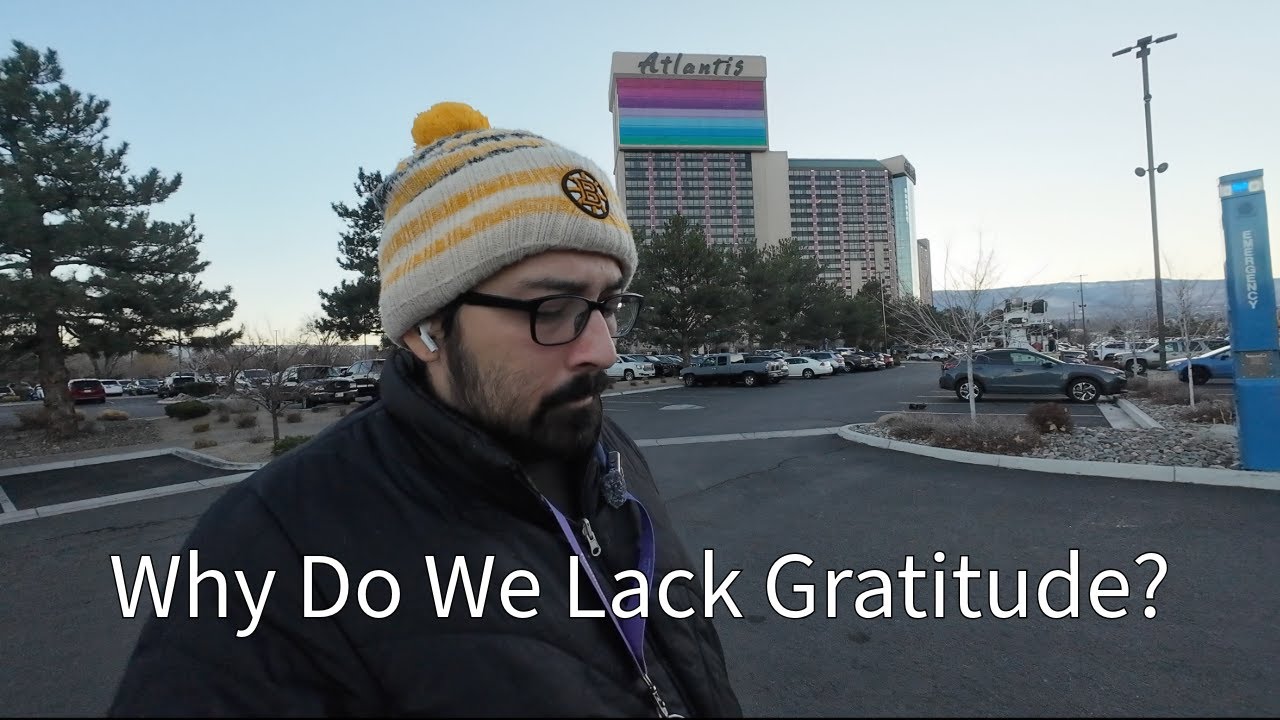
Hey YouTube, Alex here and in today's video I want to talk about this topic.
Why do a lot of Americans seem to lack gratitude?
It's by no means an exhaustive list.
Sure, there's plenty of American people that do have a sense of gratitude, but I've noticed it's just a common thread, some of that ongoing culture shock that I'm experiencing since I came back to US about 6 months ago after 2 years in Southeast Asia.
Now, I don't know how much of the online discourse is shaped by bots, but some of this stuff I've definitely noticed just being out and about in public.
So, without further ado, let's go ahead and get into it.
The top reason is the individualist culture.
It really goes into every aspect of life, but people are more focused on achievement than operating with like grace, respect.
These characteristics I've noticed more in Asia.
People are very much about themselves and you notice it in the driving patterns, the way that people treat each other, look at each other.
It's definitely been a big adjustment for me coming back here, seeing how people drive very aggressively.
People insult each people honk at each other.
people.
A lot of it does come into the driving culture because even if you don't interact with people face to face as much due to the growth in technology, you definitely see it on the road.
Recently, I drove down here to Reno, Nevada, and I had somebody driving aggressively behind me, tailgating me.
I pull over to let them pass.
They lay on the horn.
They accelerate really quickly.
I keep driving along because I plan enough time.
I don't have to hurry.
I always give myself uh room for a time to get to wherever I'm going.
I just plan ahead.
If I'm going to be late, so what?
Well, I go about 20 miles down the road and sure enough, I see California Highway Patrol has pulled this person over and now they're really late, right?
If they were late or if they hadn't planned ahead, now they're really going to be late because of course law enforcement is not going to just say, "Oh, you know what?
you're in a hurry, better let you go.
Unless it's like a medical emergency, which case I think they'd escort that individual to the hospital or those people to the hospital.
Now, you're going to be stuck there and you're going to get a big ticket.
And you see this in all areas of you see this in all areas of society.
People often wonder, why is it so regulated?
Why is it such a nanny state?
Part of that is because it's a low trust society.
People in some cases, they don't trust themselves, but basically they're all out for themselves.
When you don't have gratitude for the things going right in your life and you're in a hurry because of economic stress I'll get into later in this video, then there's this tendency to I don't know, it's weird.
I've had some conversations with Americans where where they will constantly steer the topic back to themselves.
That's interesting.
What about me?
Well, yeah, I think this and I think that.
And there's this fine line between being more individualistic or being more opinionated and being over-the-top selfish.
And I think it's something where people are so worried about where they're at, I think some of it's financial pressure, they just don't consider other people.
Even I'm guilty of this behavior being self-centered.
But I have had to cut some people off because it's just tedious to have a conversation with them.
Now, I do think that people have an internal sense of gratitude, but I tend to think they just don't really express it vocally much.
Now, finally, I just don't see near as many homeless people as I do here in Northern Nevada.
People think that California is the only place with homelessness.
But due to the broken social contract, more and more people are homeless to the extent that it's just about every town has a substantial homeless population.
Even small town America has them.
It might not be readily apparent in some places.
Some cities have what you'd call a zone of containment.
Look, there's too many of you to get rid of legally in a palatable way for voters, but we can't just have you going everywhere.
So, you just stay in this area and it's okay.
Some cities don't, like Reno, where I'm at now, there's homeless people all over the city.
And it's really unfortunate.
A lot of local Neadans, not Native Americans, but people who grew up here but aren't indigenous, cannot afford to live here anymore.
And many of those people end up on the street.
Some would say, "Oh, it's out of state people.
If I'm coming from out of state, why would I go to Nevada?
Why would I not just go to California next door that has a lot more resources for homeless people?" Anyway, let's move on to point number two.
Why Americans lack gratitude?
Number two is the high expectations.
You see this among expat communities.
It's typically the American expat who's being very loud and why don't you have this and why don't you have that and why are you taking so long and why can't you go faster and what about this and what about that just seems to be a common issue throughout the US it's more pronounced in big cities but even in small towns I've seen entitled behavior one of the last times I was in small town Tennessee these two guys were berating the waitress because I think there was a menu item that wasn't there wasn't available or Maybe their food was not exactly the way that they wanted it, but the way they approached it was lacking grace.
Cuz I always get people anytime I say anything negative about the US, I always get these rural people that claim, "Well, it's only in big cities." It's not only in big cities.
I've seen entitled behavior all over America.
It's not limited to one demographic, one type of city, one region of the country.
I think that it's just a consequence of economic growth.
The broader culture does seem to have this sense of entitlements or rights as opposed to privileges.
People feel that they have a right to subservient customer service.
People feel that they are entitled to education.
They don't see good customer service as a privilege.
They don't see quality education as a privilege.
I think this is why you see so many people with so many demands in part politically and I think some of this is a function of the country getting poorer.
I've talked about this before, but I think that this is one of those consequences where people don't know how to handle living standards declining and they think if they get loud, more aggressive, more demanding that living standards will improve.
And I don't see it that way, but a lot of people do.
People feel entitled to break the law.
You saw this during co with all of the theft, the looting, people fighting over toilet paper.
None of these people thought, "Wow, I'm lucky to have some things going right in my life.
I'm fortunate to be in a developed country." It was more like this sense that they're focused on whatever small thing that they don't have.
The next point here is consumer culture.
And there's no better example than a casino.
And I know they could be a lot of fun.
A lot of people enjoy spending time there.
I'm certainly not going to critique them for getting theirs in a capitalist society.
But yeah, this consumer culture, people feel like if I've got the money, then I deserve everything that money can buy and I deserve to always get my way.
where I noticed in Southeast Asia, people are often more accustomed to not getting their way, but also people seem to have a greater sense of gratitude.
I Sorry guys, I want to wander more, but they play music throughout the parking lot, I guess, to be festive to try to get people in that I'm going to go in there and spend a bunch of money mindset.
I've stayed here, by the way.
It's a nice hotel.
It's a nice property.
I definitely recommend checking them out.
I always stay there after Burning Man.
I didn't realize there would be music being piped through.
So, I don't know what happened here.
I don't know if somebody tried to break into this place.
It looks like there's a Veterans Administration sign up ahead.
But this is the kind of stuff that, you know, somebody felt entitled to try to get whatever they have in this building.
I don't know what's in there.
It's none of my business.
But I can certainly see based on the wooden boards that they probably had a problem with people trying to get in there without permission.
I think that's one of the consequences of hardcore advertising is you do see people willing to resort to crime to try to get certain nice things for the necessities in this country.
You have shelters, you have subsidized housing, you have food banks, you have transportation subsidies, especially in the cities, but even in some rural areas.
So, as far as the necessities go, I find that while they are expensive, you have alternatives to uh stealing or to committing crime, but a lot of people, they feel entitled to taking things that aren't theirs.
And I think when you're in that entitlement mindset, thinking about what you don't have, it's the opposite of gratitude.
It's the opposite of thinking, "Wow, isn't it lovely?
I've got food in my stomach.
I've got a safe place to stay." These are all things I'm guilty of, by the way, guys.
I'm not above this.
I Some people think that I don't have the self-awareness.
No, no.
I've acted very entitled in the past.
I've had an ex-girlfriend call me entitled, arrogant, a lot of not so great qualities.
that I readily admit to and own up to.
I'm trying to have less of those negative behaviors or attitudes as I get older.
I think they're to be expected in teenagers.
I think when you see them [snorts] in older people, it's embarrassing.
It's humiliating for them.
You wonder what happened in their life for them to develop such an attitude.
But anyway, yeah, this consumer culture doesn't reward gratitude.
And in many cases, you don't have the ability to repair items.
I remember when cell phones, smartphones first came out, you could change the batteries out.
They were interchangeable, and you could really stretch the life of a phone out that way.
Now, you don't have such a possibility.
They're all engineered to not have interchangeable or replaceable batteries.
So, the businesses and the corporations in this country encourage some of this attitude of entitlement, this consumer culture, because if you are wealthy enough, like let's say you're CEO of a Fortune 500 company, even a small company, you have enough money to not deal with a lot of these problems.
You could pay somebody to go to the DMV for you.
In California, it's famous where you can actually pay somebody to wait in line at the DMV for you.
You can pay somebody to wait in customer service for you.
Hey, executive assistant, you're going to call customer service for me to get this thing handled.
I don't want to stand around all day and wait for them.
Meanwhile, your average Joe, your middle class or workingclass people have to suffer from outsourced customer service where you're demanding to not speak to AI or some kind of robot.
You're demanding to talk to an actual American person.
And many companies don't care.
They've got your money.
They know that through regulatory capture, you probably lack alternative choices.
Living overseas taught me a lot about the United States.
A lot of things I never would have learned had I stayed here because it's a bubble where you don't really see how the world works in some sense because the US is like the stage or or having front row seats to the show and you don't know what it's like in the nosebleleeds until you go abroad.
I found in some cases wellto-do people can be very entitled and very expectant.
And if you don't do things exactly the way they want, they're angry because they're used to people anticipating their needs.
If you're very wealthy, it's often unidirectional.
A lot of wealthy people outsource or basically delegate all the stuff they don't want to do.
And so they're in this position where they're used to people taking their order.
They're used to people always doing what they want.
And that fosters some of that culture of entitlement where in a recession like now we're in a downturn.
They don't want to call it a recession because it can hurt consumer confidence even more.
I do believe the government is lying about the economic data.
Then the only people spending money are the top 10%.
the people who will spend regardless of macroeconomic conditions.
And so I think that increases entitlement even more because those people know that the economy is in a bad state.
If you're wealthy, you know a lot more about economics than the average person.
And you know when people are having a hard time, you know when people are struggling to find work.
So yeah, I'll get off the soap box about that rant.
I don't blame people for wanting to get wealthy.
I don't I don't blame people for wanting to improve their lives, but these are things that I've noticed.
The fourth point here is chronic stress.
I've noticed Americans these days seem a lot more stressed out than when I was a kid.
Those were the hion days.
The economy was really good.
People seemed really happy and upbeat in general optimistic.
And now because of inflation, I would even say stagflation.
It's not so much that everybody's stressed out.
It's that a lot of people are stressed out.
And even if you're calm, you're going to deal with apathetic people because there's a probably 20 or 30% of the population that knows they're probably never getting out of poverty.
They're probably never going to substantially improve their economic situation.
And I'm going to sound really entitled here, but I've gone to fast food establishments where I waited for a half hour for my food and the employees were joking around, goofing off.
He he haha.
And initially I was annoyed and then I thought about it.
I'm like, they're hardly getting paid.
What do you expect?
Do you expect people making This was in rural Tennessee probably 10, 11 bucks an hour maybe 2 or 3 years ago.
to care, to have some strong sense of duty.
At those pay rates, business owners are lucky people would even show up.
You're definitely not getting ahead on that wage.
You're not going to save a substantial amount of money.
You're basically just scraping by.
And these people are stressed out.
They're poor.
They're probably in a bad housing situation.
They probably eat poor quality food.
They probably have bad relationships, all of which are common among workingclass people.
And so, of course, they're going to have a who cares attitude.
Of course, they're going to want to blow off steam.
They probably have to try to pick up extra hours when they can.
They might have an additional job on the weekends.
And I don't really blame people.
That's where I have some sympathy for bad driving sometimes where it's like, well, on one hand, you're reckless.
What you're doing is dangerous.
On the other hand, you probably can't afford that vehicle.
You may be in danger of losing your job.
I feel really bad for the people with families.
I think that you probably need an income of around $300,000 a year to support a family with a decent lifestyle, particularly if you're in a major city where a lot of the jobs are or the suburbs of a major city where a lot of people commute from.
So chronic stress definitely will cut into people's ability to feel gratitude because they feel like, well, 20 years ago I lived pretty good.
30 years ago, I live pretty good.
Today, maybe not so much.
I think that's where it's important to live below your means.
But you have to be making decent money to live below your means.
You're not I make $15 an hour, but I live like I'm making seven.
I guess you could live in your vehicle.
One, that's not legal for a lot of people.
Two, that's not safe for a lot of people.
So, I think some of it, you probably think I'm conspiratorial, but some of it is to get rid of poor people.
With the rise in robotics, I think that there's less of a need for working people, and this is a subtle way for the powers that be to reduce expenses on in terms of law enforcement, court system, hospital bills, all these things are very expensive.
I think that's where a lot of people are struggling with gratitude.
It's like, okay, I can survive, but like if I'm not supporting a family, if I don't have the opportunity to start a family, what do I really have to look forward to in the future?
No kids, no grandkids, probably not buying a home in the desirable places to live or even the acceptable places to live.
Most of my friends that are my generation who have become homeowners have had to go down several tiers to become a homeowner.
And I'll have to do the same.
If I plan to buy a house in maybe 3 or 4 years, I'm going to have to uh go for something less than what I expected when I was growing.
The final thing here is distrust in institutions.
And a lot of people just don't trust the government.
They don't trust large businesses.
They don't trust their neighbors.
There's just this strong sense of America having shifted to what you might call a low trust society.
And when people don't have this sense of trust, why should they be appreciative when they're in flight or fight mode, trying to figure out, how is this person trying to manipulate me?
How are they trying to get over on me?
People don't trust their employers.
They're asking, "What is my employer trying to do to manipulate me to get me to work more for less money?
Are they going to lay people off?
When are they going to lay people off?
Are they going to lie about laying people off?
There's so little trust in our society today.
That's part of the reason online shopping is popular.
I was reading an investment thesis for Amazon and one of the major arguments the author made, this is not investment advice, but one of the major arguments they made was well with delivery, Amazon has less theft.
They have less risk of theft.
theft is more manageable where retail theft is more expensive to deal with.
You have to have loss prevention where package theft is dealt with by the government in a retail theft setting.
In many places, yeah, you can call the police, but their top priority is often other more serious crimes, not necessarily stopping somebody from stealing from Walgreens or comparable retailers.
And the staff is not trained law enforcement.
The staff is trained to process transactions, stock shelves, provide customer service.
In some cases, they're not trained to wrestle and take a wouldbe thief down and hold them on the ground.
They probably a lot of them don't have jujitsu skills.
Yeah, I would say the low trust society factor is a big one as to why people are lacking gratitude these days or seeming to lack gratitude these days.
Let me know what you think down below.
Do you agree with any of these?
Do you disagree with any of these?
It always helps to generate interesting discussion and dialogue when we talk about these subjects together.
Please subscribe if you haven't already.