Hey YouTube, Alex here.
Good morning to you from Dumaguete.
I'd like to contrast some of my videos that you could say have been a bit negative at times.
I think those topics are really important to cover because life overseas is anything but perfect.
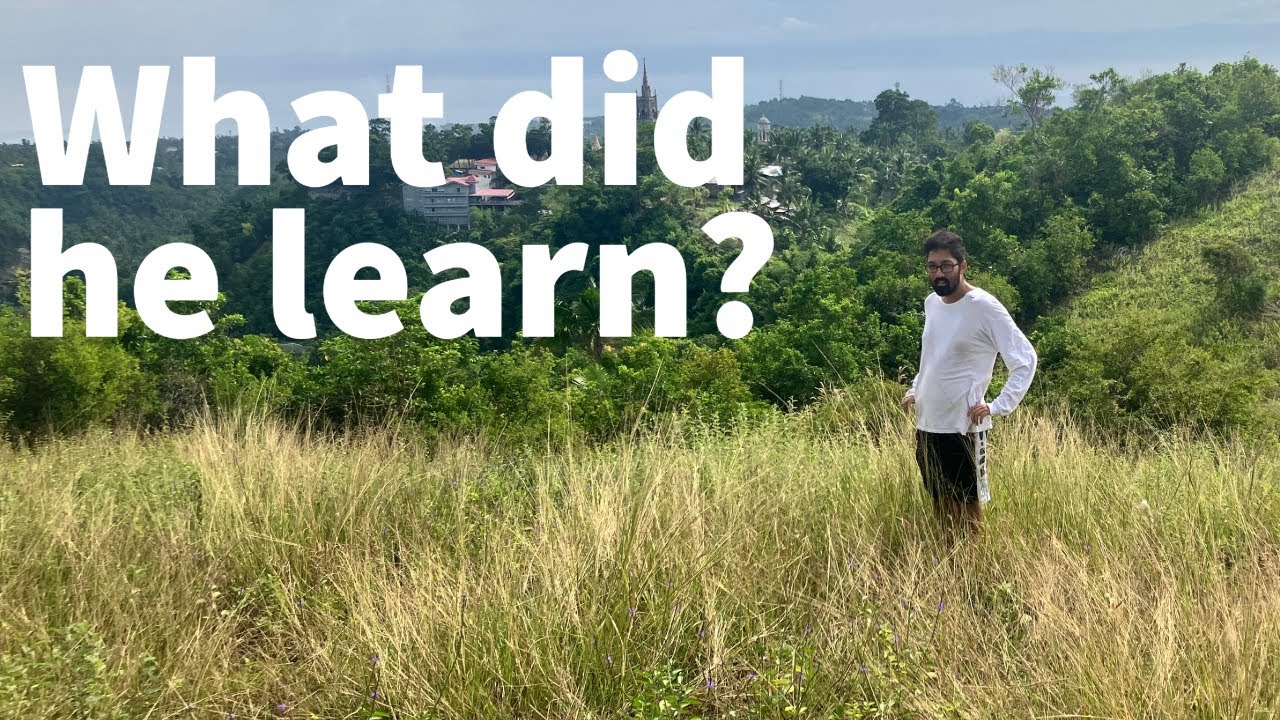
I thought I'd talk about five reasons as to how the Filipinos have influenced me.
So, let's go ahead and get into it.
Reason number one is that I am more cheerful.
So, I found that the Filipino people are generally very cheerful people.
I see people doing difficult jobs with a smile.
I see people working long hours, smiling, generally just giving it their best.
And it reminds me, wow, so this person, they're probably working 6 days per week.
They may be struggling in some other areas of their lives, and yet they still bring this cheerful attitude to work.
They still maintain this smile and this optimism.
I see people having fun at work too sometimes and I just think, wow, like this is not an easy job they're doing.
In some cases, it's very physically demanding.
In some cases, it's very mentally demanding.
In many cases, it's both.
And yet, they still maintain this cheerful attitude.
I just think about my predisposition to not always being so cheerful.
It's made me more self-aware to be here when my mind is racing and I'm thinking about something else entirely and then I encounter some Filipino people and they're just smiling and laughing, joking around, having fun and it's started to make me more self-aware.
And so when I find Filipino people joking around or smiling or laughing, I try to join them and laugh and joke around with them too, it always seems to take the mood up a notch even more.
Like being around them can be healing, I think, for a lot of us foreigners.
And it reminds me of the phrase laughter is the best medicine.
So I find that I'm more cheerful here.
Even if it might not always seem that way with the heaviness of some of the topics that I cover, I overall do feel more cheerful here.
If you see me out with any of my friends, we're always smiling and joking and laughing and just having a good time.
And I just wasn't like that back home.
Back home, I was always stressed out about tomorrow.
I was feeling regret about yesterday.
Just never living in the moment.
always worried about some other time or some other place or something else I had to be doing.
And I just took myself way too seriously.
I'm not an ordinary foreigner.
I'm such and such at this company and I'm going to be this at this company next year.
And I'm constantly striving toward something more.
And that gets into another point in this video is gratitude.
I'm more grateful person now that I've spent time around Filipinos in the Philippines.
I took life so seriously in the US.
every single minute of every single day had to be productive.
Had to be used efficiently.
I didn't have patience.
Snap, snap, snap, chop, chop, chop.
Uh if something wasn't done efficiently, if something wasn't done quickly, oh, I can't believe this.
This is the end of the world.
I just don't have that attitude here.
If something's a little bit slow, I laugh it off.
I've had numerous situations here where things did not go perfectly.
I just start laughing.
Not in a way to mock them or not in a way to make fun of them or anything like that, but just finding humor in the situation.
Like, ah, guess that's the way the cookie crumbles.
Not a big deal.
Most of the problems, none of the problems I've encountered here are so severe that it's worth getting upset over.
Just I've learned to laugh, learn to be more cheerful from the Filipino people.
And it's been all around good for my mental and physical health.
Is every single day perfect in the Philippines?
not in my experience, but more days than not are filled with laughter, filled with humor, and I just have this cheerful feeling that I didn't really have back home.
Maybe some of it's the weather.
I definitely think some of it's the people.
I've noticed that most of my friends mentioned being more cheerful as well.
The last thing I'll note about this is that when I got here, I was smiling so much and the muscles in my face weren't used to smiling.
So, I felt the strain in my face muscles from smiling and laughing so much.
You might notice that as well.
I'm not sure if you've had that experience, but that's definitely been an experience for me.
The next point here is that I don't talk bad about the future, or at least I try not to talk bad about the future.
There's a saying in Filipino culture, or a belief in Filipino culture, that if you talk bad about the future, it will come true.
And when I was back home in America, I was always worried about the future.
Oh, when is rent due?
When is this bill due?
When am I going to have to make this payment?
When is the commission check going to clear?
I was a salesperson.
When is the commission going to come in because I need it because I need to pay this.
I need to pay that.
I was constantly worried about the future.
Constantly thinking, "Oh, tomorrow's going to be bad.
My boss is going to have a problem with this or that or the other.
I made a small mistake.
I'm going to get chewed out for it." You just have this constant state of anxiety about the future.
or at least I did in the States where nothing I ever did was good enough and I was just waiting for the hammer to drop the second shoe to fall and you just live in this constant state of fear back in the US.
You turn on the news back home and it's oh this bad thing is going to happen, this bad thing is going to happen and it's just this constant stream of negative predictions about the future and this could happen and that could happen.
I remember talking to my buddy last night about it.
I remember thinking back home, I can't be late to work because if I'm late to work and I lose my job, then I'm not gonna have any money.
If I don't have any money, I can't pay my rent.
If I can't pay my rent, I'm gonna get evicted.
And if I get evicted, I'm going to be homeless.
And if I'm homeless, I'm going to get arrested for vagrancy.
And if I get arrested for vagrancy, I'm not going to have any money to pay my bills.
I find that back home, there's just this constant state of anxiety about the future, worrying about what bill will come up, worrying about losing your job, worrying about making this payment, worrying about making that payment.
there's always some kind of payment coming up.
Even if you had the cash to pay, you're worried, okay, if I forget to pay it, I'm going to get hit with a late fee.
I don't want to go on autopay because they might raise the fee up without me noticing.
So, I'll just make the payment each month, but I better not forget because if I forget, they're going to charge me extra money and if I don't have that extra money.
And so, there's just this constant treadmill feeling of always being behind, always feeling late.
even when you're on time.
I've heard the phrase if you're on time, you're late.
And so I was constantly worried about the future.
And here I'm less worried about the future.
Of course, I think the natural human state is anxiety and anxiousness, but I'm not to the same extreme where I feel that my functioning is impacted by my stress and worry about the future.
Will the future be perfect?
Probably not.
Probably won't be perfect.
Do I worry every second of the day about it?
No, not really.
I think things will work out now.
I think for better, for worse, I'll survive.
There's a sense of optimism I feel here.
Things are going to work out.
That I don't need to talk bad about the future.
That by talking bad about it, I'm setting myself up for failure.
I'm also not so important that it's going to be the end of the world.
If I misstep or something like that, who cares?
I'm not that important.
I'm not in some position of great authority where, oh no, the future of humanity is resting on your shoulders.
Oh well, so what?
You know, if something bad does happen, I'm sure I'll figure it out.
I'm sure I'll deal with it.
I'm sure it won't be the end of the world, and I'll probably be stronger and wiser having had the experience.
The next point, point number three, is I have more gratitude.
I was staying at a homeay a few months back and I get dropped off by my trike and I'm walking toward the house and a few steps away from the trike and it's maybe 500 m to the house the rain all of a sudden starts to pour down like it goes from no rain to lots of rain very very quickly and I'm thinking great now I'm soaked my clothes are wet I'm just miserable I got to go back I've got to peel my clothes off and I've got to peel my clothes off and put on some dry clothes and just feeling annoyed.
And I get to the gate of the homeay that I'm staying at and I open the gate and I see the father of the family and he's sitting there looking up at this guy like this and he's smiling and I thought why is he smiling like it's pouring down rain and I realized wow so he he came from a farming background.
They have a little farm there.
And for him, the rain meant that the crops would get the water that they need.
And I thought that was so powerful that we're having the same experience of the same stimuli and yet we're having totally different reactions to it.
For me, it's this inconvenience, right?
I'm thinking, "Wow, why does it have to rain now?
Why doesn't it wait until I get back in the house?" For him, it meant the vegetables are going to get a bunch of water.
we're not going to have to water as much.
We save water there.
And so there's many different instances where I encounter Filipinos exhibiting gratitude for very, very basic things, things that I would almost consider a burden, right?
I mean, I'm thinking this water is a burden.
It's making my clothing wet.
I'm going to have to hang them up to dry.
I'm going to have to put on some more clothes.
And for him, he's just happy about the vegetables.
So that's another area of my life where the Filipinos have really helped me to improve and to be more self-aware and to have more gratitude for the things that are going right in my life and to try to not solely focus on my struggles or my difficulties, things that aren't going right.
I've been to restaurants and I thought, man, this food is nothing to write home about.
I regret spending my money here.
And I look over at other tables and I see Filipinos smiling and laughing, enjoying their meals with their families.
They're not concerned that it's not perfect.
And I think that's another element of gratitude where many Filipino people express gratitude over very basic things.
And I remember seeing recently a woman of very little means, let's say.
I'm not going to give any more specifying details, but needless to say, this woman obviously is of very little means.
And I thought, what an awful life.
Like, how does she make it through the day?
Does she have any joy or anything that brings her happiness?
And I encountered her more recently, and she didn't know that I was there.
I think just the angle she was smiling and dancing and laughing and playing with her grandson or a young man I assumed to be her grandson.
And I just had the thought, wow, she can find joy in something so basic.
Even though it's obvious that she's struggling in many different ways, it's obvious that she's struggling.
She still manages to have gratitude and to smile and laugh even though it's readily apparent she's had a hard life.
It's very obvious from observing her and seeing the way that she lives her life that she's not had an easy go of things.
And yet even somebody as hard up as her can find joy as something so basic as singing or dancing.
Uh where in the US some people really do enjoy dancing, but I find other people it's got to be perfect.
They've got to perfectly choreograph and curate every single move.
And uh sometimes they can't find the enjoyment in something so basic.
The key takeaway here that I've learned is I try to have gratitude even for things that back home I would have looked at it is oh whatever that just is what it is.
I try to savor each bite when I have a nice meal whether it's by myself or with friends.
I try to have gratitude when I go out for a walk and I'm looking at this beautiful jungle that I'm living in, this rainforest, and I see these ocean views and the sky is this beautiful pink color with siki underneath and the ocean below that.
The Filipinos have really taught me a lot about gratitude and about being happy with what you have and taking joy in some things that we totally overlook in the West.
We totally take for granted.
The next point is I have more patience and that's putting it lightly.
About 3 or 4 months into my Thailand trip, this was last fall and I'm walking really fast through Chiang Mai.
I'm zooming around people wondering why are they walking so slow?
But why is everybody walking so slow?
Why is everybody so chill?
And I was still in sped up mode.
And I had this moment where I paused and I'm like, why am I in a hurry?
Where am I going that's so important?
I need to rush around.
Am I going to be late for a meeting?
This is ridiculous.
I've got to slow it down.
And I've talked to friends that moved here to Southeast Asia and they've had the same experience where they caught themselves in a rush and they just stopped and they're thinking, "Why am I in a hurry?
I'm gonna shave two and a half seconds off of my trip.
I'm going to shave two and a half seconds off of my trip for very little reward.
Back in the US, I had very little patience.
I felt that in the US, I was often punished for being patient.
Here in the Philippines, if something goes differently than what I planned, I just shrug, laugh it off, don't make a big deal out of it.
Sometimes I go to a restaurant and the food is a bit slow.
Sometimes I go to a restaurant and I get something different from what I ordered and sometimes traffic is a little bit slow.
Sometimes I go to the grocery store and there's a long wait.
I've learned to be more patient.
It's not been an easy journey.
There have been times where I felt like I was a little bit impatient, but I've slowed down my thinking to where I think I think more clearly here.
I think I speak more clearly here.
I think I make better decisions over here because I'm not in such a state of rushing to try to meet some arbitrary deadlines to deal with manufactured urgency, not actual urgency.
I've worked in so many corporate jobs, not healthcare, where a delay can have a serious consequence, but just a basic corporate job, there's just this manufactured urgency.
Rush, rush, rush.
You got to get it done.
You got to get it done.
And I'm all about working hard.
I work as hard as I possibly can.
But there are times where in the working world in the states you are rushing not because there's major benefit but because there are arbitrary goals that are not clearly measurable.
I'm not saying don't have goals.
I'm not saying goals aren't important.
I do think goals are important.
There are times at which people have unrealistic goals.
For some people it's a good thing.
I think for some people they strive to achieve.
For other people they feel like they are never good enough.
They get it in their head.
Nothing I do is good enough.
No matter what I do it won't be good enough.
I am insufficient.
And that can lead to substantial issues.
The Filipinos have taught me not only to be more patient with other people.
Even more importantly on some level to be more patient with myself to have empathy for myself to think you know what it's okay.
It's not the end of the world.
you didn't do things perfectly.
I think about one of my good friends, I'm not going to mention her name, to maintain our privacy.
I was doing that thing some of us foreigners do for emotional support where we talk to a Filipina who's a platonic friend of ours and we're talking about something that's bothering us and she looks at me and we make eye contact and she says, "Nobody's perfect." And she gives me a big smile and I just have this thought wash over me.
Look, I can't expect myself to be perfect.
I need to have patience for myself.
and she clearly has patience for me, for my mindset, let's say, at times.
And uh yeah, so Filipino people, they've taught me to be more patient with others and with myself.
It's something that we're lacking in the modern world is a sense of patience.
I think that part of having that identity as a productive member of society is this idea that I am so important and everything I do is so important and is a makeorb breakak situation.
And it's not so much that we're not that important.
It's not okay.
Something didn't go right.
Unless you are a health care professional, it's not going to be the end of the world.
It's going to be okay.
Things are going to work out.
People have survived for much longer than a millennia with far fewer material resources than I have at my disposal.
The wealthiest king of England 500 years ago never had.
Even a hundred years ago, let's just say even a hundred years ago, did not have this device in his hand.
didn't have the camera I'm using, he probably wouldn't be able to travel to the Philippines.
Like, I can just get on an airplane and go.
It's incredible what we have in the modern world that we take for granted and that we overlook because we are in such a rush that we don't even think about the systems in place that help us to be more efficient and how much more productive we are, how much more we can get done.
Finally, I have learned to be impatient with my own actions.
is just try to take as much action as I can.
Be patient with myself but not with my actions.
Have a bias toward action.
Meanwhile, I'm also patient with the results of the people around me.
And I don't have this expectation of chop, chop, chop.
Something goes wrong.
Half the time it's not even their fault.
They're just the tip of the iceberg.
It's not reasonable to get upset with somebody because, oh, my meal is delayed.
Chances are your server wishes things could go perfectly, but for whatever reason they haven't that day.
The final point, I am more social because the Filipinos have taught me to be more outgoing, to be more social.
I struggle with social anxiety off and on for much of my life.
Back home, I feel a little bit of self-consciousness.
Like, if I don't say the perfect thing in the perfect way, people are going to be offended.
People are going to take offense.
If I don't tow the line and say exactly what people want to hear, which seems to change from day to day and changes based on the person, I just felt that it became exhausting to talk to other people because every interaction was this performance that had to be curated.
I had to think about the other person's background and oh, we got to know about their political beliefs and every little part of it had to be calculated to the point where I felt like it was a job just to talk to somebody else.
And if you said the wrong thing, they immediately are on you and want to critique or to tear apart what you said.
And it's like verbal combat.
It felt like verbal combat trying to talk to people a lot of the times in the US to the point where you just give up.
like you're so desiring conflict and dealing with manufactured outrage that it just becomes a chore to talk to other people.
And I find that to be much less the case here.
I find people are easy to talk to.
People are approachable.
If somebody's busy or doing something, they'll give me the the eyebrow raise.
They'll give me that acknowledgement that, hey, I'm busy right now, but I see you.
I notice you.
And you feel validated.
You feel like you're not invisible.
A lot of guys that come over here talk about how they felt invisible back home and they don't feel that way here.
And I think that's so true.
I really love that about the Philippines in particular that the social environment is so rich.
If I walk from my apartment to town, half the time I'm running into somebody I know.
If I don't run into somebody on the way, I will run into somebody at my destination.
And I can just cycle through like five or 10 different places in town and I'm going to run into a friend at at least one of them.
At least one friend.
I don't think there's been a day where I've gone out searching for a friend that I haven't found one, had a great conversation.
There's so many opportunities to socialize here.
I don't ever feel lonely.
I don't ever feel like I'm missing out.
Back home, it felt like you just didn't have the same opportunities to socialize.
And I think the Filipinos are the origin of that.
foreigners who might otherwise not be super social people.
They get influenced by the people here to be more social.
There's been so many times where a Filipino person has stopped me.
I'm in a stressed out mood for some reason.
They cheer me up.
They smile.
Hey, sir.
Hello, sir.
How are you doing, sir?
And I just feel this boost in my mood that's really infectious.
My social life here is just incredible.
I love it.
Did I have friends back home?
I definitely had friends back home, but people are so busy.
People are rushing from job to home to chores in a circle.
You just don't have the time with friends back home that you have over here.
And the time that you do have with friends is much more often spent trying to decompress from work, trying to de-stress, trying to unwind from what's going on in your head and what's going on in your life.
And it's so nice to have that social life here.
I really like it a lot.
I like that I can hang out with friends.
I like that I can meet up with friends.
The Filipinos have really taught me a lot in that regard.
To take time to socialize, to be friendly, to be cheerful, to joke around with people.
They just have a certain energy or a vibe about them where I see people always making time to have fun and to enjoy life.
There's so much that we can learn from Filipinos.
This is just the tip of the iceberg.
There's so many things that the Filipinos have taught me and continue to teach me through the way that they live their lives, through the way that they operate.
I have so much gratitude for being a welcome guest here.
I look forward to much more time spent in the Philippines.
I think there's such a bright future ahead.
So, let me know what you think down in the comments below.
What have the Filipino people taught you?
Probably some of these resonate with you.
Maybe some others I didn't get a chance to mention in this video.
Next, give us a thumbs up.
it helps with the YouTube algorithm.
And finally, subscribe to the channel down below if you want to see more content like this.
And we'll see you soon.