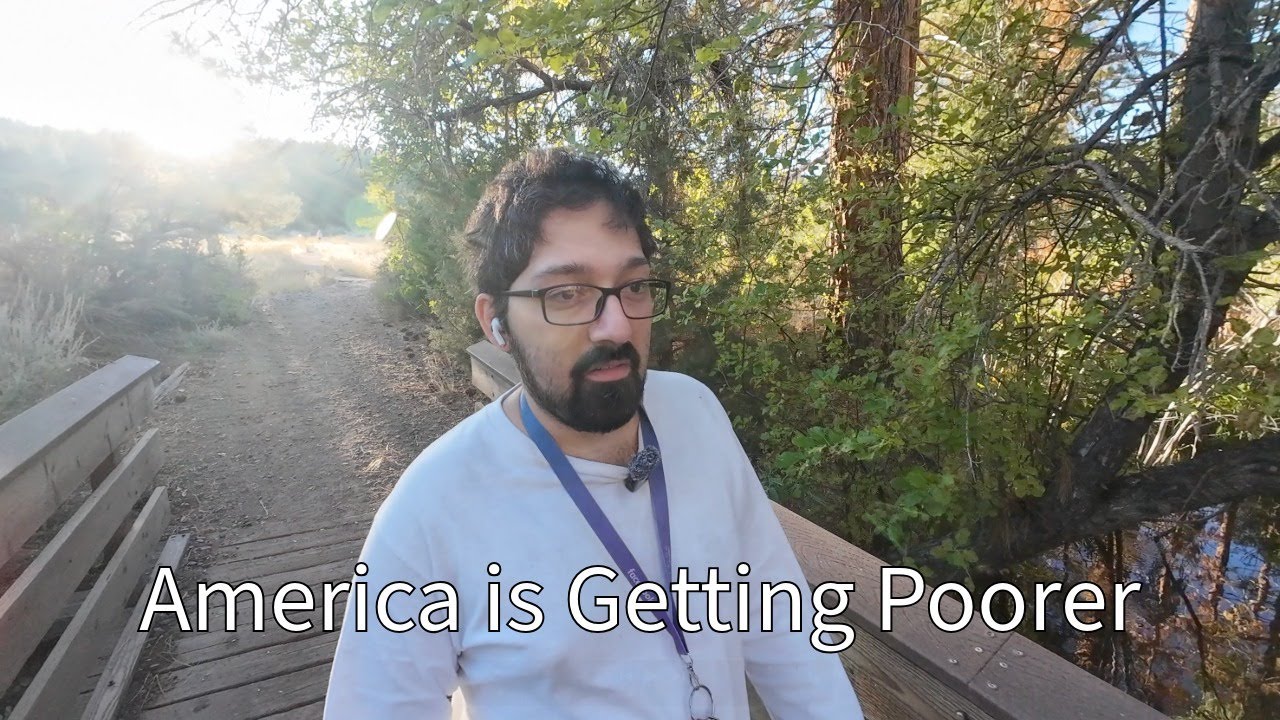
Hey YouTube, Alex here and in today's video I want to discuss this topic.
A lot of people are of the other understanding that the United States is a wealthy country and I generally agree with that.
But I'd also assert that even though the GDP number keeps going up due to money printing, the country is not as wealthy as it used to be.
You might ask, what does this have to do with expat life?
Well, I think it's spurring people to become expats.
I think that's part of the reason why, my opinion, it's probably one of the unifying reasons why so many people want to move abroad.
I don't think it's the only reason, but I if you ask me what do most American expats have in common in 2025, I would say that many of us are economic refugees.
um we can't maintain the standard of living in the United States that we uh grew up with in many cases or we don't believe the economy has enough opportunity such that in our lifetimes we're going to be able to achieve those economic milestones uh or many of us will not.
I think this is part is true for young people.
So let's go ahead and get into it.
you know, this video is not meant to offend people.
It's just my observations.
If you disagree, let me know what you think down below.
Uh, so the first reason is that uh you hear a lot of people going childfree or getting pets instead of having kids.
And uh there are plenty of reasons to go child-free or to not have kids.
I know some people unfortunately it's due to biological reasons.
It's not an economic thing for some people out there.
They don't really have one of these alternative reasons like you know unfortunately due to biology they can't uh or they have other personal reasons.
It comes down to economics.
I think you see this a lot on Reddit for example when people talk about how expensive it is to have kids.
And so uh I think an alternative some people are finding is well I still want the action of uh taking care of a living being.
So I'll get dogs or cats that will be my kids.
You hear about like uh pet parents or pants you know that kind of thing.
And I think that some of that is a result of the economic problems in the United States.
You go back, and I'm going to use this example throughout this video.
You go back to like a historic time.
Uh it would be very atypical for people to uh not have children or to have pets as a substitute.
But I think what's changed is that kids, but even pets, uh can be economic liabilities.
And I think pets are less of an economic liability than children.
But I remember growing up hearing you're fed and clothed.
Uh people claiming that's a sign of good parenting that they buy clothes, they shelter and feed their kids.
Those are required by law.
If you are in custody of a child, you're legally required to provide certain things or you can be penalized.
I remember when I used to live in Colorado, I used to go thrifting a lot.
There was a couple that lived in an RV near one of the thrift stores.
One thing led to another.
The woman got pregnant, had the baby, and then several months in, friend of mine uh who's acquainted with this couple mentioned, you know, they had their kid taken.
I was like, why?
What happened?
They they're not really allowed to do that.
Like, what do you mean they're not allowed to do that?
Well, you can't really raise a kid in an RV and then uh commit some kind of crime and then when CPS gets involved, they see, oh, you're living in an RV that's in Denver gets really cold.
So, an RV may be sufficient for part of the year, but there's months where it's far too cold to safely live in an RV.
I know people, some people do it anyway, but when it comes to kids, you've got to meet certain standards.
As public schools get worse, a lot of people have concerns about public school systems.
Thenuh private schools have to raise tuition, right?
You get more demand.
You got to charge more money to offset the risk of overcrowding.
So, I think as kids and raising kids becomes more and more expensive, more people will opt out of them.
And you might ask, well, where does becoming an expat come into play here?
Well, there are people that have found, hey, look, it's much cheaper to raise a kid in Southeast Asia.
So, that opens up the doors for still engaging in parenting, but oh, you know what?
We get plenty of support from my significant other's uh family.
We are not having to pay several I've heard of people paying like $500 a week for daycare.
I'm sure it varies uh by city and by number of kids, neighborhood, that kind of thing.
But um you know, having extended family to step in and help out, that's going to reduce the cost.
They probably have cheaper private schools.
Clothes and food are going to be cheaper.
It's just all around cheaper to raise a kid overseas.
So, uh some people when faced with not having kids or having kids in a lower cost of living country, they're going to opt for the ladder.
they're going to say, "You know what?
I can't do it here, but I can do it over there." In regards to pets, pets can be very endearing.
They can be very sweet, loving.
I'm not a pet hater.
But when I think about passing on genetic material, when I think about continuing a legacy, I I don't have kids and I don't have pets.
So, let me get that out of the way.
I just don't think that pets are the same thing.
Pets can be wonderful.
I'm not discounting their value, but when it comes to the continuation of society, not really sure that we could call them the same.
The next point is that I personally feel that the value of human capital is not what it used to be.
For me, I'm pretty overweight right now.
I need to lose weight.
I am not as valuable uh in certain types of jobs as I would be if I were in better condition.
If you were to want to hire me for say a firefighter job, certain law enforcement positions, I simply am not capable of the output of a an in shape or fit person.
And this is just kind of the start, but I'm not the only person that struggles with this.
I think there's a lot of people struggling with their weight.
Some people still have their po their co gains.
Uh this weight I primarily gained after I came back from overseas and went from walking like 10 15,000 steps a day to none.
Just is what it is.
I'm actually working on losing it.
It's going to be timeconuming.
It's going to be slower for me to lose it than it took for me to gain it.
But when I think about human capital, the United States, I think that we battle between excellence and equality.
I guess I'm seeing this specifically with my home state where a lot of people are moving in from states where they invest more in their people.
They have higher taxes and so they spend more money on education.
They spend more money on uh libraries and nonprofits and uh social clubs.
And these people who have had this investment from living in wealthier states, California, New York, Massachusetts, they're in many cases dramatically out competing the people in my home state.
They're often coming with a better education, a larger bank account.
They're already plugged into these industries.
So, if the office moves to my home state, they're transferring with the office.
So, they've had these built-in connections prior to arrival.
Uh, and they're just all around what you might call better capitalized.
Uh, conversely, people in those states tend to have fewer kids.
So, there's often this uh, well, you look at the movie Idiocracy where it's largely like really not so bright people having lots of kids.
And I think this is true to some extent the United States.
And I'm not one for eugenics.
I'm not anti people with less, you know, having kids.
But when it comes to human capital, I think it's a fair point that we need to have certain standards for education, for exercise, for many different areas of life, intelligence, being able to produce things.
And I think that when you take a look around, it's just not what it used to be.
I think it's underinvestment.
I think it's inequality.
I think there's a lot of things that go into that, but you hear it from the older generations a lot.
Oh, these young people this and these young people that.
And there was a time when I took offense to that.
To some extent, I think it could be out of touch.
But I also think, man, may there might be some insight into that.
And so, I did more research and I realized, oh yeah, like when everybody goes to college, it's not as valuable and the standards have to lower because the colleges want the money.
Um, so if you're not going to an Ivy League or you're not going to like a state school with a history of quality education, United States is as competitive as it gets.
You need every single advantage working for you if you want to be successful in the United States or hit maximum capability.
And if you don't, somebody who got that right, got that part of their life right, is going to pass you.
I think about specifically, there was the example that came to mind.
and it just slipped my mind.
But oh yeah, so uh a relative of mine when they were going to high school, this was during the George Bush eras, they had no child left behind and his school told him and his mom, just come to school and we'll pass you.
He was sleeping the entire day.
He was skipping a lot of school.
He was just not attending class.
And they just told him, "Look, if you just come to class, we'll get we'll graduate.
You just show up.
You don't have to do anything.
Just show up." Well, showing up at school is just a start.
Okay.
Of course, you back then especially, you had to be there if you're in the public school system.
But you actually have to pay attention.
You have to take notes.
You have to be learning.
You have to be tested.
It's like if I walk around the library, am I going to learn anything?
No, I have to actually sit down, pick out some books.
I just have to I have to pick out some books, sit down, open them up, go through them, maybe do some exercises on that material.
And so that's another example where he was let down by the system.
He was let down by the leadership in his family.
But that's like across a lot of the uh southern states.
There's just not the same appreciation for education in my opinion.
But that's a whole other debate.
But I think that directly translates to human capital being less valuable.
When people are not getting quality education, I just don't think they can perform as well as some other places that are more competitive.
Korea, China, Japan, Singapore are examples of uh countries with very competitive education systems.
People invest a lot into education.
They take it really seriously.
Where I was taught by some people in my community growing up, oh, the teachers are losers.
People become teachers because they're not qualified to do something more important and better paying.
That's going to vary by state.
California, they get paid a lot more than my home state.
This next point, it's going to be hypocritical of me, but I think people don't dress as well as they used to.
I think another sign America is getting poor is that people dress poorly compared to how they did in the past.
You can tell I don't really dress that great.
I wear sweatpants and sweatshirts when I'm not at work.
I think it's a sign the country is getting poor.
I mean, if you look at like old films and you read old books, people talk about dressing properly.
And it wasn't just a rich people thing.
I I know rich people could afford better quality clothing than the working poor, but I remember seeing what you might call like period pieces based in places like New York or Chicago, turn of the century vibe, and you see even like kids selling newspapers would be dressed up pretty decent.
I've seen like pictures of San Francisco for example, Market Street, not what Market Street is today, but what Market Street used to be 100 years ago.
And people have got uh really nice clothes on.
And I was watching a video from Analyzing Finance with Nick and he mentioned people used to spend upwards of 10% of their annual income on their wardrobe.
Nowadays, it's more like 2 or 3%.
Do I think people should go back to that?
I don't think it's realistic with housing taking up a larger portion of income, but I think it's just worth noting when you're not dressed as well.
I I personally think it causes me to be a little bit sloppier, a little bit less tuned in, a little bit less ready to go.
Where when I dress up, I wear nicer clothes.
I feel more confident.
I feel more like I'm ready to take on the challenges of the day.
I feel, you know, better all around.
Now, I think a lot of people wear athleisure.
A lot of like you go out, you see the it's people at Walmart.
They got the the sweatpants on, they got the sweatshirt on.
They're not really dressed up like they're going anywhere.
I think that's another reason people quit going to church.
It's like, look, if I I'm worried about paying for my rent and I'm worried about putting food on the table.
Why am I going to keep a a church wardrobe?
All the expenses associated with going to church.
I've got to tithe.
I've got to potentially go out to a nice restaurant afterwards.
These are things that some people more than some people are cutting out because they feel that they are too costly.
And I think a lot of people are getting more into investing and thinking, "Wow, you know, I could go spend all this money on dressing up or looking nice." Or I could put it away in my 401k, my Roth IRA, an investment account or portfolio where it'll work for me because, you know, nobody really cares if everybody if one person dresses like an athleisure.
Oh, it's a travesty.
If half the people you see in public are wearing athleisure, I think you can no longer really jump on those people as abnormal, I think it just becomes part for the course.
Not judging anybody.
I, as you can tell, I wear this way.
I dress this way.
Not judging anybody.
As you can tell, I dress this way.
But it's certainly worth consideration.
The fourth reason is stuff just looks kind of run down when you're driving around.
I think like buildings just don't look as nice as what they used to.
I think there's some exceptions, some particularly affluent areas where lawns are wellkept, but I noticed in a lot of places stuff just looks kind of tired.
Compared especially to places I've been recently in Vietnam or like Soul, Korea, it just I don't know what exactly what it is.
I think some of it's maintenance costs, but I think as these buildings get more expensive to maintain, I think as lawns get more expensive to maintain, people are going to opt for cheaper solutions to deal with these things.
I've noticed, you know, just even in my old neighborhood where my grandma used to put all her free time into the lawn, they put up like a greenhouse and an RV pad and you never would have seen in that neighborhood.
Another thing you see in that neighborhood is used to be that people would handle their yard work themselves.
For better, for worse, this isn't a judgment, but you see lots and lots of Hispanic people doing a lot of this type of work.
And so I think for those who want it done, they're opting for more people that are willing to work for a more modest wage versus in the past where people, oh no, I'm not going to trust somebody else with my lawn.
I remember one of my friends dads growing up, we would make fun of him because of how into his lawn he was.
He always had the I think it was the Kentucky tall fescue long cut, 2-in long cut.
Very, very specific about his lawn.
And I think now 15 odd years later, if you go back to that neighborhood, very few people are doing their own uh yard work.
Those who could not afford to pay somebody else to do it, I think they're going to opt for like cheaper setups.
Maybe they put more rocks, maybe they put in like fake grass.
But this is another example where I think the country is getting poorer is that people Oh, you also have a lot more renters now.
And I think if you're a renter, you don't really have the pride of ownership.
I certainly don't.
I don't disrespect rental properties I live at.
I I treat them with respect and care.
If for nothing else, I want to get that deposit back.
But am I going to go above and beyond to paint everything to uh do roof repairs to No.
No.
And so I think that's another factor where people don't seem to have that same pride in their neighborhoods and where they live.
Speaking speaking of that, uh, one of the things I noticed in the neighborhood I grew up in is you see this proliferation of German shepherds and I think even some pitbulls.
And you know, when I think about those situations, I'm thinking maybe they can't own a fire because they're a felon.
They've committed some serious crime.
They're not permitted to have uh that solution.
So, they go for what they perceive to be an easier solution than Second Amendment.
I'm not pro or anti-second amendment.
It's just an observation.
I see a lot of dogs out here and just in general compared to what you used to see.
You go to any park, you're seeing people.
I see people with their dogs off leash just about every day.
Their dogs come up, they're wanting to jump on you, lick on you.
People, they don't want to invest the money or they don't have the money to get proper training, right?
They don't want to train their dogs to be respectful of other people's boundaries.
They may work long hours or odd hours or they can't be consistent about the training.
But this is another example of the country getting poorer.
I think too you see this where people I don't know if it's a lack of education, they don't understand the liability.
I say this cuz my grandparents had some guard dogs at one point and they attacked some kids in the neighborhood and they got sued and their homeowners insurance went through the roof and that was very costly where today I don't know some of these people were so in love with these potentially dangerous dog breeds that they would probably thank you if your dog bit them.
Oh, I just love dogs so much.
which I love them more than I love having on my fingers.
They're just so precious.
Yeah, it's it's another sign that uh the societyy's getting poorer.
Just an observation, not a dog hater, but I don't think they're substitute for people.
The fifth point is the normalization of lack behavior.
You see this on the news.
I don't know exactly if you could pinpoint it to one circumstance or another, but people losing their cool in public.
I see it a lot.
People seem much more tense and stressed out uh due to the economy, due to people becoming poorer.
You just see people more sarcastic, more confrontational, more aggressive.
When I was growing up, I always thought of America as this shining beacon on the hill and these people that hold themselves to a higher standard than other countries.
And now that I'm an adult and the economy is not what it was when I was a kid.
It was very strong when I was a kid, I see people that act in very uncou and this is across the United States.
people playing loud music in public.
People talking on their phone loudly in public.
You see it at the airport.
I've seen a lot of funny videos of people getting arrested at airports.
I've uh have some friends that work in law enforcement and talking to them is always a enlightening uh conversation.
just disgusting the way some people behave, the way they they act totally wacko.
And I think some of this might have been spurred on.
I mean, I I say it's economic, but some of it also, I don't know if it's chicken or the egg, but reality TV, we all have seen people on reality television shows doing all kinds of crazy stuff.
Like I think of Jersey Shore specifically as an example of a show where people are acting really wild, but there's a lot of shows that display people behaving in a really unsophisticated manner, let's say.
And so, yeah, I think the country is becoming poor.
I think it's evident in all these reasons.
If you're a subscriber, you've probably seen examples or could think of examples of people who act in ways in public that they wouldn't have in the past.
And some might say, well, it's just cuz we have more cameras now.
But I think there's more to it than that.
People just don't have that same feeling of optimism.
And two, I think if you're somebody that is incapable of working and you're not working, you're not worried about losing a job.
Well, who cares how you act in public?
Most of the people I hang around have jobs or are employed.
They don't want to get on video um using slurs against other people, being aggressive.
They don't want to go to jail.
They don't want to do anything that could jeopardize them earning their paycheck and going home safely.
I think there's more and more people that feel like they've been cut out of that kind of lifestyle uh or can't participate in that kind of lifestyle and they don't have as much to lose.
I think that's part of the economy is poor economy is people just don't feel like they have as much to lose.
You hear about a lot of people not wanting to work and it's like, well, if I'm not able to get ahead by working, why basically participate in society?
So, I think that's where the social contract is is broken.
But let me know what you think down below.
This video has gone on pretty long.
Maybe you totally disagree.
That's okay.
For those who are not yet subscribed, please subscribe.
That helps us to uh grow the channel and helps you to see more videos.
Give us a thumbs up.
Please comment down below.
Do you agree that America is getting poorer?
or do you disagree?
Do you think that America is wealthier than ever and it's not really realistic to note these points?
It's always interesting to see what people come up with.
Thanks so much, guys.
Bye-bye.